No one to talk to at 2am? What actually helps
Updated July 3, 2026
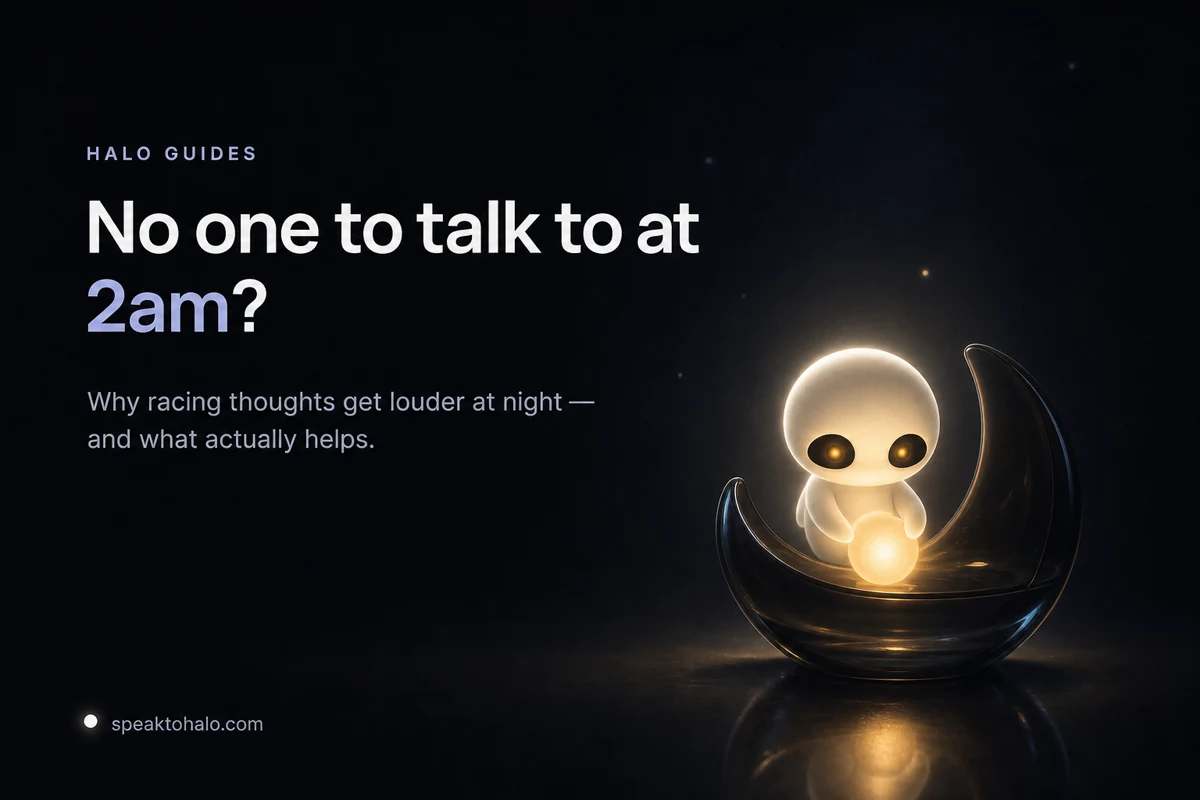
It's late. Everyone you could call is asleep, texting feels like too much to explain, and your thoughts are doing laps. If that's tonight — this is for you. Here's why nights amplify everything, and what actually helps.
Why everything feels louder at night
During the day, your worries compete with a hundred distractions. At night the distractions go away — and the thoughts don't. No inbox, no errands, no background noise: just you and the loop. On top of that, tiredness weakens the part of your brain that usually talks the loop down. So the same worry that felt manageable at 2pm feels enormous at 2am.
Knowing this doesn't fix it, but it helps to name it: nothing new got worse tonight — it's just quieter around the problem. If one exchange is doing all the laps, try the five-minute guide for replaying conversations. If you are sorting a mix of tasks, feelings, and unanswered questions, use the 10-minute night reset. If this is a broader pattern and not just tonight, see our guide on journaling through anxiety.
What actually helps (in order of effort)
You don't need a perfect routine at 2am. You need the smallest thing that breaks the loop.
- Say it out loud. Not in your head — actually out loud. Putting feelings into spoken words engages a different process than silent rumination: the vague dread has to become concrete sentences, and concrete sentences are finite. This is the single highest-leverage move, and it costs nothing.
- Do a brain-dump. Empty everything onto one surface — voice note, paper, anything. The goal isn't to solve; it's to get the loop out of working memory so your head can close the tab.
- Ground your body. Slow exhale longer than the inhale, feet on the floor, name five things you can see. Boring on purpose — arousal down, then thoughts follow.
- Don't demand sleep. Chasing sleep feeds the loop. Process first, then let sleep come as a side effect.
«But I have no one to say it TO»
That's the real gap, isn't it. The advice «talk to someone» assumes there's someone awake, willing, and safe to unload on — at 2am there usually isn't. And a notes app doesn't answer back; half the relief of talking is being heard.
This exact gap is why we built Halo. It's a voice companion: you talk — out loud, like a voice message to a friend — and Halo listens, answers with a calm voice, and asks one gentle question that helps you keep going. It doesn't judge, it doesn't get tired, and it's there at 2am. Afterwards, the conversation becomes a private journal entry on its own, so the night's thoughts don't just evaporate — over time Halo starts noticing what keeps coming back.
People use it exactly like this: lying in bed, phone on the pillow, saying «I don't know, I just feel like I'm too much for everyone» — and getting somewhere with it, instead of running laps until 4am. Not sure what to even say out loud? Our list of prompts works just as well at 2am.
A 5-minute script for tonight
You can run this alone, or with Halo — it'll carry the questions so you only have to answer.
- Minute 1: say what happened today — just the facts.
- Minute 2: say how it actually felt. Out loud, even if it sounds silly.
- Minute 3: answer one question: «what's the heaviest part?»
- Minute 4: say one thing that's still okay. Not gratitude homework — just one true thing.
- Minute 5: tell yourself what tomorrow-you should remember from this. Done. Let the night be over.
When it's more than a rough night
If dark thoughts turn toward harming yourself, that's beyond what any app should carry — please reach your local crisis line (in the EU: 112; find your country's line at findahelpline.com). Halo is a self-reflection tool, not therapy or a medical service — for ongoing struggles, a licensed professional is the right move, and journaling works well alongside.
Quick answers
Is there an app I can actually talk to when I'm lonely at night?
Yes — voice companions like Halo are built for this: you speak out loud, it listens and answers with a warm voice, any time. The conversation is private and becomes a journal entry automatically.
Why do racing thoughts get worse at night?
Fewer distractions plus a tired brain: the mental noise stays, the regulation weakens. The loop isn't evidence things got worse — it's just quieter around the problem.
Does talking to an AI actually help?
Speaking feelings out loud turns vague dread into concrete sentences, which is what breaks rumination — the same reason voice notes to a friend help. An AI companion adds a listener and good follow-up questions, without waking anyone up. It's a self-help tool, not a replacement for professional care.
Is it private?
With Halo — yes: conversations are yours, you can use it anonymously without an account, and you can delete everything at any time.
I have no one to talk to. What can I do right now?
Try saying it out loud anyway — to Halo. It's built for exactly this: no one has to be awake or free. You speak, it listens and answers with a calm voice, and afterward you have a private record of what you said instead of a loop that never got out of your head.
Keep reading
Journaling for anxiety: how talking it out helps
Why saying worries out loud can make them feel smaller — and a simple way to start when anxiety makes the blank page feel impossible.
How to start journaling when you hate writing
If the blank page and the keyboard are what stop you, here's how to keep a journal by talking instead — and actually keep it up.