How to stop overthinking at night: a 10-minute reset
Updated August 11, 2026
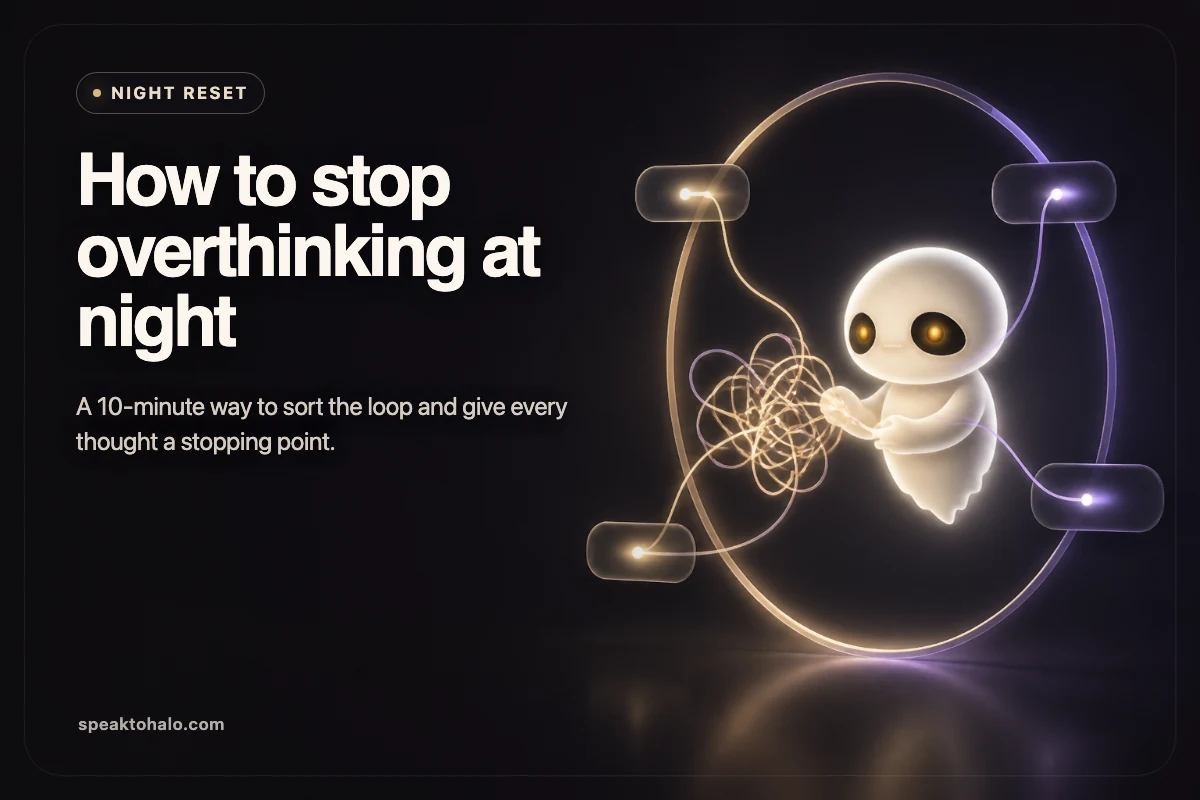
It is 12:17am. You have replayed the meeting, reorganized tomorrow, imagined three bad outcomes, and somehow remembered an email from 2019. Your mind is treating every thought as unfinished business. Give it ten minutes and four places to put the mess.
First, stop asking for a blank mind
Trying to force every thought away gives you another job to fail at. Tonight's goal is smaller: work out which thoughts need action, which need a later time, and which do not have an answer yet.
You are building a stopping point, not proving that everything is fine. Use paper, a note on your phone, or your voice. Keep the lights low and set a ten-minute timer so the exercise cannot quietly turn into another hour of analysis.
Name the kind of loop you are in
Most late-night overthinking in this exercise goes into one of four buckets. A thought can fit more than one; pick the label that gives you the clearest next move.
- Task. Something real needs doing: send the document, book the appointment, buy the train ticket.
- Conversation. You are replaying what someone said, rewriting your reply, or guessing what they meant.
- Feeling. The thought keeps changing, but the embarrassment, anger, grief, or fear underneath it stays the same.
- Uncertainty. You want an answer that is not available tonight: whether they will call, whether the application worked, what the test will show.
The 10-minute night shutdown
Start wherever you are. The timer matters more than the format.
- For two minutes, capture each thought as a fragment.
- For two minutes, mark every line T, C, F, or U.
- For four minutes, give each marked line one destination.
- For two minutes, read the stopping point out loud and close the note.
Minutes 0–2: capture fragments, not a life story
Write or say the thought in the form it arrives: “deck is not ready”, “Sam's face after I spoke”, “what if the rent goes up”, “I feel stupid”. Do not explain the backstory. You are taking attendance.
If the same thought returns, put a dot beside the first version instead of writing it again. Three dots tell you that the thought is loud; they do not make it three separate emergencies.
Minutes 2–4: mark the loop
Put T beside tasks, C beside conversations, F beside feelings, and U beside uncertainty. This is deliberately rough. “Sam's face after I spoke” might be C and F, but choose the part you can handle tonight. If the question is really “did I offend Sam?”, that answer is unavailable until you ask. Mark it U.
Minutes 4–8: give every line one destination
Now finish each line without trying to finish the whole problem.
- Task → next action and time. “Open the deck at 9:15 and fix slide four.” If it has a place tomorrow, it does not need rehearsal tonight.
- Conversation → fact, guess, choice. Write one fact, name what you are guessing, then decide whether to ask, apologize, or leave it. If one exchange has taken over the night, use the fuller guide for replaying conversations.
- Feeling → one honest sentence. “I am embarrassed because I wanted to look competent.” The sentence does not need a positive ending.
- Uncertainty → missing information and earliest answer. “I will know after Thursday's email.” If there is no new information available, another round of thinking cannot complete the task.
Minutes 8–10: say the stopping point
Read the destinations once. Then say: “I have written down what needs tomorrow. I have named what hurts tonight. The rest is waiting for information.” Change the words until they sound like something you would actually say.
Close the note when the timer ends. If your body is still alert, choose something quiet and familiar that does not ask for more decisions. The reset is complete even if sleep does not arrive immediately.
Move the thinking window out of bed tomorrow
The NHS suggests setting aside a short, regular “worry time” to write concerns down and look for solutions. Try ten or fifteen minutes earlier in the evening. When a loop returns in bed, you can point it toward a time that already exists instead of reopening it from scratch.
Tasks can get an even narrower treatment. In one controlled sleep-lab study, 57 healthy adults aged 18 to 30 wrote for five minutes before bed. The group who wrote future tasks fell asleep faster on average than the group who wrote completed activities, and more detailed to-do lists were associated with shorter sleep-onset time. It was one night with a small, young sample, not a test of treatment. Treat a bedtime list as a simple experiment, not a cure. Read the study.
If tasks are the main noise, the five-minute brain dump gives you a daytime-friendly way to capture and sort them.
If talking is easier than writing
Say the fragments out loud and keep the same four labels. A voice note works. So does a short call with someone you trust. With Halo, you can talk through the messy version, answer one relevant follow-up, and keep the conversation as a private journal entry.
Keep the boundary: one short conversation, one stopping point. Halo can help you reflect, but it cannot promise sleep or tell you what another person is thinking.
A note on wellbeing
A rough night is not a diagnosis. If racing thoughts or worry keep disrupting sleep or daily life, a qualified mental-health or sleep professional can help you work out what is going on. Halo is a reflection tool, not therapy, diagnosis, medical advice, or crisis care. If you may harm yourself or someone else, contact local emergency or crisis support now.
Overthinking at night: quick answers
How do I turn my brain off at night?
Do not aim for a blank mind. Capture each thought, label it as a task, conversation, feeling, or uncertainty, then give it one destination. Close the note after ten minutes even if every problem is not solved.
Why do I overthink when I am trying to sleep?
The day has stopped giving you new inputs, while unfinished tasks and worries are still available. That quiet can make the loop easier to notice. If it happens often or seriously affects sleep, talk to a qualified professional rather than trying to diagnose the cause yourself.
Does writing a to-do list before bed help?
A small one-night sleep-lab study found that healthy young adults who wrote future tasks fell asleep faster on average than those who wrote completed activities. That result is promising but limited; use a five-minute list as an experiment, not a sleep treatment.
What should I say when I am overthinking at night?
Try: “This is the thought. This is the part I know. This is the part I am guessing. This is what can wait until tomorrow.” If you are talking to Halo, start with the messiest sentence and ask for one stopping point.
Keep reading

How to stop replaying conversations in your head
A five-minute way to separate what happened from what your mind keeps adding — and decide whether the conversation needs action or an ending.
Brain dump journal: a five-minute reset
A practical five-minute method, a messy example, and what to do after every loose thought is finally out of your head.