5 anxiety journal prompts: the same structure, every time
Updated July 4, 2026
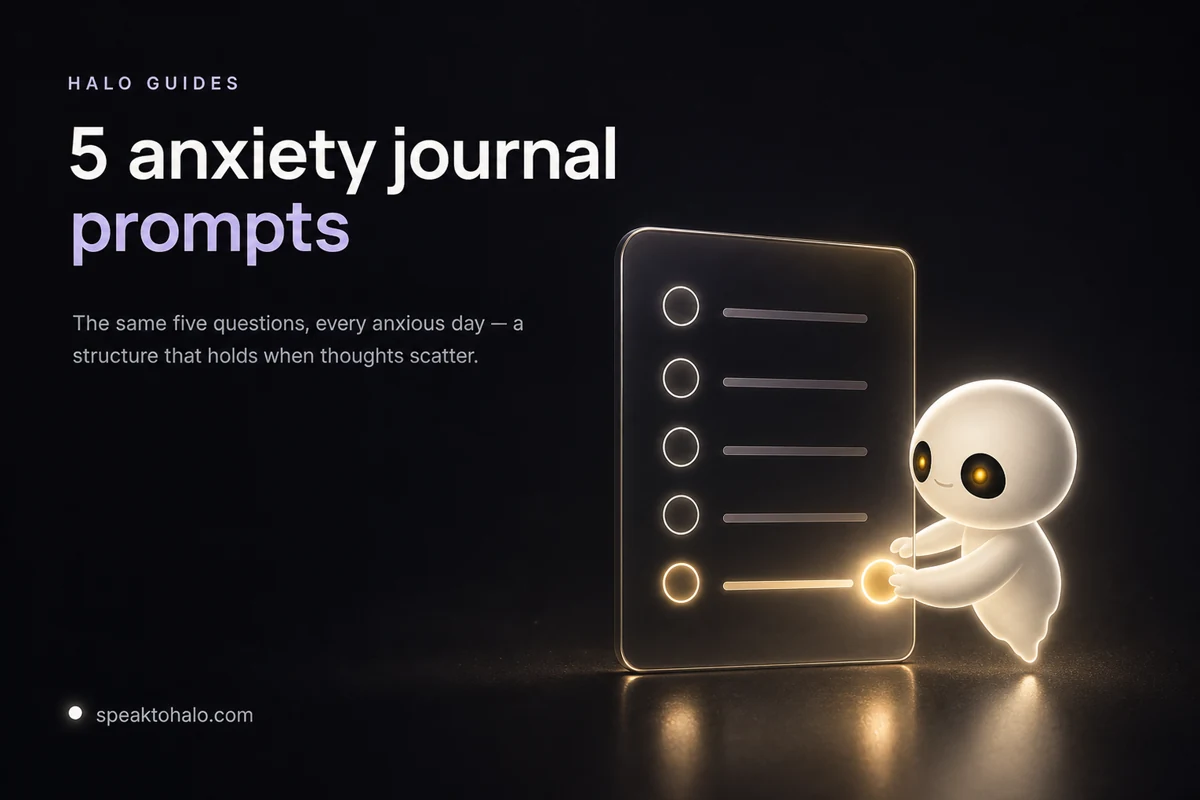
"Just start a journal" is easy advice and useless instructions. If anxiety is why you're looking, you don't need inspiration — you need a repeatable structure, so you're not facing a blank page while your mind is already racing. Here's one that works, whether you write it or say it out loud.
Why a plain blank page doesn't work for anxiety
Generic journaling advice — "write about your feelings" — assumes you already know what you feel and can put it in order. Anxiety does the opposite: it scatters thoughts sideways and makes even picking a starting sentence feel like a decision. A blank page just adds a second problem on top of the first.
What actually helps is removing the decision entirely. A fixed structure means you're not writing an essay from scratch every time — you're filling in five known slots, in the same order, every day.
The structure: five parts, same order every time
This isn't a rigid worksheet — it's a rhythm. Once it's automatic, you'll move through it in under five minutes.
- 1. Name the trigger. One sentence: what specifically set this off? Not "I'm anxious" — "the email from my manager" or "the appointment tomorrow."
- 2. Name the physical feeling. Where do you feel it in your body — chest, stomach, jaw? Naming the physical sensation pulls attention out of the spiral and into something concrete.
- 3. Name the actual fear. Not the surface worry — the thing underneath it. "I'm worried about the presentation" often hides "I'm afraid of looking incompetent." Write the real one.
- 4. Rate how likely it is. On a 1–10 scale, how likely is the feared outcome, honestly? Most anxious predictions, written down and rated, turn out lower than they felt in your head.
- 5. Write one next step. Not a solution to everything — one small, doable action, or "nothing, and that's okay for tonight."
Why this works better than free writing
This structure borrows from CBT thought records, which is why it works: anxiety thrives on vague, unbounded worry, and this format forces every worry into a specific, bounded shape. A vague dread ("something's wrong") becomes a concrete claim ("I think I'll get fired if I make this mistake") that you can actually look at — and most concrete claims, once written down, shrink.
It also removes decision fatigue. You're not deciding what to write about; you're answering five fixed questions. That's the difference between a habit that survives a bad week and one that quietly stops.
When writing itself is the problem
Here's the catch with anxiety journaling specifically: on the days you need it most, sitting down to type is exactly what feels hardest. Anxious energy wants to move, not sit still and compose sentences.
This is where saying the five parts out loud works better than writing them. You can run this exact structure as a two-minute voice conversation instead — with Halo asking each part as a gentle question instead of you filling in a template. Talk through what triggered it, where you feel it, what you're actually afraid of — Halo asks the next question, and the entry writes itself when you're done. No typing required on the day typing is hardest. See our broader guide on journaling for anxiety for more on why saying it out loud helps.
A filled-in example
Sometimes a structure is only real once you see it filled in:
- Trigger: Didn't hear back about the job after the final interview.
- Physical feeling: Tight chest, checking my phone every ten minutes.
- Real fear: That I already blew it and I'll have to start the whole search over.
- Likelihood (1–10): Honestly, 3 — it's been four days, not four weeks, and they said "early next week."
- Next step: Stop checking my phone tonight. If nothing by Friday, send one polite follow-up email.
A note on wellbeing
Journaling — written or spoken — is a self-reflection tool, not a treatment for an anxiety disorder. If anxiety is frequent, intense, or affecting your daily life, a licensed therapist can help in ways a journal can't. Halo is a companion for reflection, not therapy or a medical service.
Anxiety journal — quick answers
What are good anxiety journal prompts?
A repeatable structure works better than free writing: name the trigger, the physical feeling, the real fear underneath, how likely it actually is, and one small next step. Same five prompts every time.
How long should an anxiety journal entry be?
Short. Five sentences following the structure above takes about five minutes and is usually enough — the goal is to get the loop out of your head, not to write an essay.
Can I do an anxiety journal by talking instead of writing?
Yes — voice-first journals like Halo let you speak through the same structure out loud, which helps on exactly the days anxious energy makes sitting down to type feel impossible.
Is journaling actually proven to help with anxiety?
Research on expressive writing links putting feelings into words — spoken or written — to lower anxious rumination. It's a helpful self-reflection tool, but not a substitute for treatment when anxiety is severe or persistent.
Keep reading
Journaling for anxiety: how talking it out helps
Why saying worries out loud can make them feel smaller — and a simple way to start when anxiety makes the blank page feel impossible.
What to talk about in a voice journal: 30 prompts
Stuck on what to say? 30 simple prompts to get you talking — about your day, your feelings, decisions, and gratitude.