Finch app review 2026: cost, features, and an honest verdict
Updated August 7, 2026
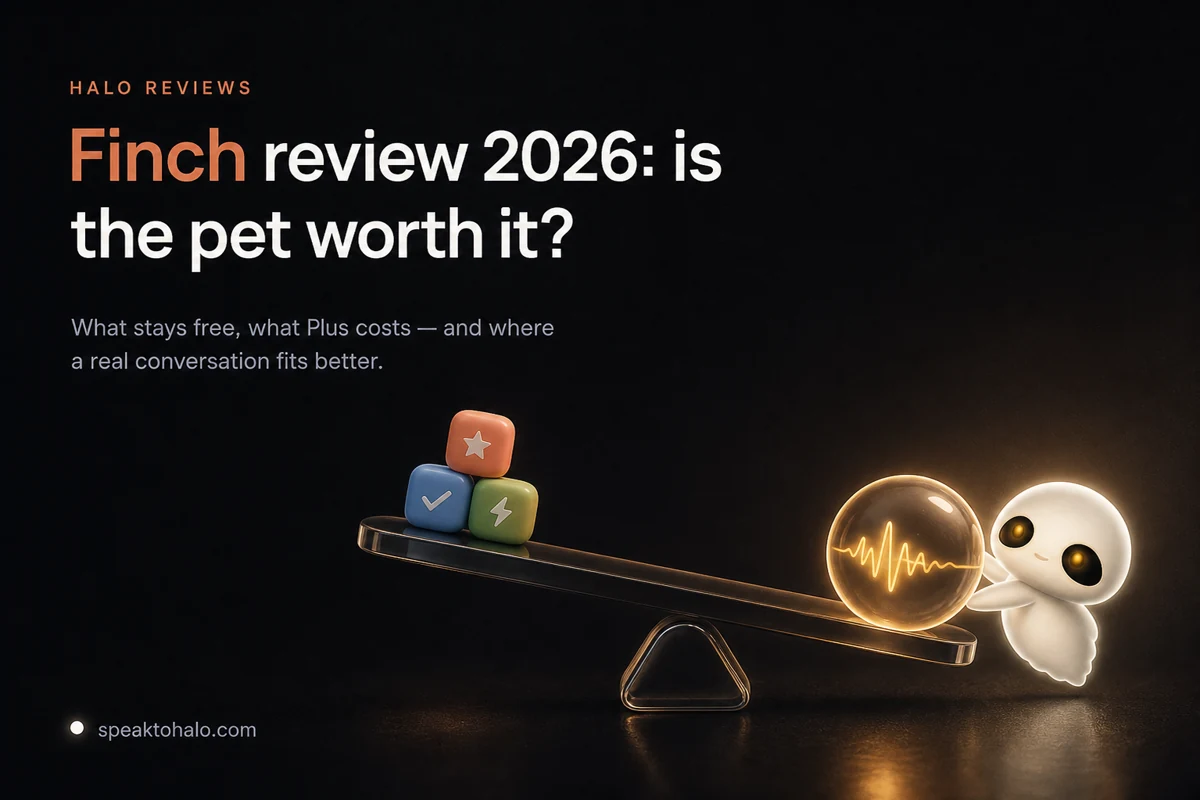
Finch turns self-care into looking after a small virtual bird. That sounds gimmicky until a two-minute task earns enough energy and in-game currency to make you want to return tomorrow. It works best when you know what needs doing and want a friendly push; it fits less well when you need to untangle a thought that doesn't have a checkbox.
The short answer
Finch is worth trying if small rewards help you begin tasks you already want to do. Its free version is generous and the design is unusually warm. You don't need Plus to find out whether the basic loop works for you.
Finch is less useful when the thing you need is an open-ended place to untangle a thought. It has reflections, mood check-ins, breathing tools, goals, and a once-daily Chat with Your Birb after an adventure. That chat responds to the bird's short story; custom replies aren't saved. It isn't the same job as a saved, open-ended journal conversation. Disclosure: this review is published by Halo, a voice journaling app, so that distinction matters to us.
What Finch actually does
Finch is a habit tracker wrapped around a virtual pet. You set goals, complete them, and send your bird on daily adventures. Finishing tasks earns energy and rainbow stones that buy clothes, furniture, colors, and travel. The app also includes mood check-ins, short written reflections, breathing exercises, soundscapes, quizzes, timers, and social gestures called good vibes.
It is not a niche app. On August 7, 2026, the US App Store listing showed a 4.9 rating from about 736,000 ratings. Apple has also named it an Editors' Choice app. Those numbers will move, but they make one thing clear: the idea works for far more people than a cute-bird novelty would.
Why the pet works
A task such as “drink water” is easy to ignore when it sits in a plain productivity app. In Finch, the same task helps a creature wake up, explore, and come home with a story. The reward is immediate and small. That can make the starting line feel closer on a low-energy day.
The bird also changes the emotional tone of a missed task. A conventional streak counter can feel like a red mark. Finch is more forgiving: the interface keeps inviting you back, and the next useful action can be tiny. That softer tone is one of the app's strongest qualities, especially for morning and evening routines.
What happens if you miss a day?
Your Finch does not die if you stop using the app. Finch's current help center describes missed days in terms of the streak: you can repair it with Rainbow Stones or freeze it in Pause Mode. There is no pet-death mechanic documented in the app's current support material.
That distinction matters in a self-care product. You may lose a streak if you disappear without pausing, but the bird is still there when you return. The app gives you another small action instead of punishing the break.
The free version is unusually complete
Finch says its core self-care features are free and will stay free. That includes caring for your bird, setting goals, reflecting, sending good vibes to friends, and taking part in seasonal events. This is not a seven-day demo disguised as a free app. You can use the basic product for months before deciding whether Plus adds anything you need.
- Set recurring goals and mark them complete.
- Use mood check-ins and basic reflection prompts.
- Care for, dress, and send your bird on adventures.
- Join seasonal events and connect with friends.
- Use a selection of breathing, movement, soundscape, timer, and quiz tools.
How much Finch Plus costs in 2026
The official US list price is $9.99 per month or $69.99 per year. Plus adds more customization, shop slots and discounts, extra seasonal rewards, all good-vibe options, more reflection prompts, and the full libraries for soundscapes, movement, breathing, timers, and quizzes.
Pricing is less tidy than those two numbers suggest because Apple's listing currently shows several Finch Plus in-app purchase prices. Check the exact plan and renewal terms on your own App Store or Google Play confirmation screen. If the free version already does the job, there's no practical reason to rush the upgrade.
Where Finch can lose its grip
The same game layer that gets you started can eventually become the main thing you're optimizing. That's not a moral failure; it's what reward systems are good at. Four tradeoffs are worth watching after the novelty settles:
- Checking the box can replace doing the task. One long-term App Store reviewer described tapping through goals for rewards after the challenge had faded.
- The collecting layer can get noisy. Outfits, furniture, travel, micropets, events, and currencies are motivating for some people and distracting for others.
- Plus offers can be confusing. The standard US list price is public, but the store listing shows more than one Plus purchase price. Read the plan and renewal terms on the final confirmation screen.
- Reflection stays guided. Finch is good at helping you check in. Its daily birb chat responds to an adventure story, and custom replies aren't saved. It isn't built as an open-ended journal conversation about the thing you can't stop thinking about.
Choose the tool for the moment
Choose Finch when you know what needs doing and need a friendly push to begin. It is especially good for routines made of small actions: take medication, brush your teeth, step outside, reply to one email, or put a glass of water by the bed.
Choose a voice journal when you do not yet know what the task is. Maybe you are irritated after a meeting, awake at 2am, or circling a decision. Halo lets you talk through that mess, asks a relevant follow-up, and saves the conversation as a journal entry. There is no pet to maintain and no checklist to complete.
| If you need... | Better fit |
|---|---|
| Motivation for a known habit | Finch |
| A playful self-care routine | Finch |
| Space to talk through an unclear feeling | Halo |
| A journal entry without typing | Halo |
The honest verdict
Try Finch free if the bird makes one useful action feel easier. Keep it if you still complete the real task after the novelty settles. The free tier is good enough to run that experiment without paying.
If the bird is not the part you need, compare our seven Finch alternatives by the job they actually do. You can also try Halo when you need to talk something through, or read our Reflectly review for a more guided journal.
A note on wellbeing
Finch and Halo are self-care and reflection tools, not therapy or medical services. If you are struggling or everyday tasks feel persistently impossible, a licensed professional can offer support an app cannot.
Finch app review: quick answers
Is the Finch app actually free?
Yes. Core features such as goals, reflections, caring for your bird, friends, and seasonal events are free. Finch Plus adds more customization and a larger library of exercises and rewards.
How much is Finch Plus?
Finch's official US list price is $9.99 per month or $69.99 per year as of July 17, 2026. Discounts and store offers vary, so check the final price shown for your account.
Is Finch good for journaling?
It is good for short, guided reflections and mood check-ins. If you want a freeform journal that responds to what you say, a conversational voice journal is a better match.
What is the Finch app used for?
Finch is used to support small self-care habits. You set goals, complete them to energize a virtual bird, and use optional tools such as mood check-ins, reflections, breathing exercises, timers, soundscapes, and quizzes.
Does your Finch die if you stop using the app?
No. Missing days can interrupt your streak, but Finch does not use a pet-death mechanic. You can repair a missed streak or use Pause Mode when you know you need time away.
What is a good Finch alternative if I do not want a game?
For talking through feelings without goals, currencies, or a virtual pet, Halo is a voice-first option. You speak, it responds, and the conversation becomes a saved journal entry.
Keep reading
7 apps like Finch, compared by what you need
A practical comparison for people who want more game, faster mood tracking, guided journaling, AI reflection, better routines, or a real conversation.
Reflectly review: a good guided journal — and its real limits
What Reflectly does well, real complaints about pricing, and when a voice-first journal fits better than a guided prompt sequence.